
The hard part of software was never the code.
I. The Inversion
Everything you know about building software is organized around a bottleneck that no longer exists.
For sixty years, the central problem of software engineering has been the same. Translating human intent into working code is slow, expensive, and error prone. Every methodology invented since the 1960s, from Waterfall to Spiral to Agile to SAFe, has been a different answer to the same question. How do we manage the cost of writing code?
Waterfall tried to get it right the first time. Agile tried to get it right iteratively. Both assumed that writing code is where the work lives, and everything else, documentation, specification, testing, exists to support that central act.
That assumption is now false. AI agents can generate syntactically correct, functionally plausible code faster than a human can describe what they want. The cost of producing code has collapsed by orders of magnitude, and it continues to fall. A function that took an engineer an hour to write, test, and debug can be generated in seconds. A module that took a team a week can be produced by a fleet of agents in an afternoon.
Here is what has not collapsed. The cost of knowing what to build. The cost of understanding a domain deeply enough to specify its edge cases. The cost of designing interfaces that will survive contact with production. The cost of constructing tests that define correctness precisely enough that a machine can verify it. These upstream activities, specification, architecture, and test design, remain fundamentally human, cognitively expensive, and irreducibly complex.
The bottleneck has moved. The entire discipline must move with it.
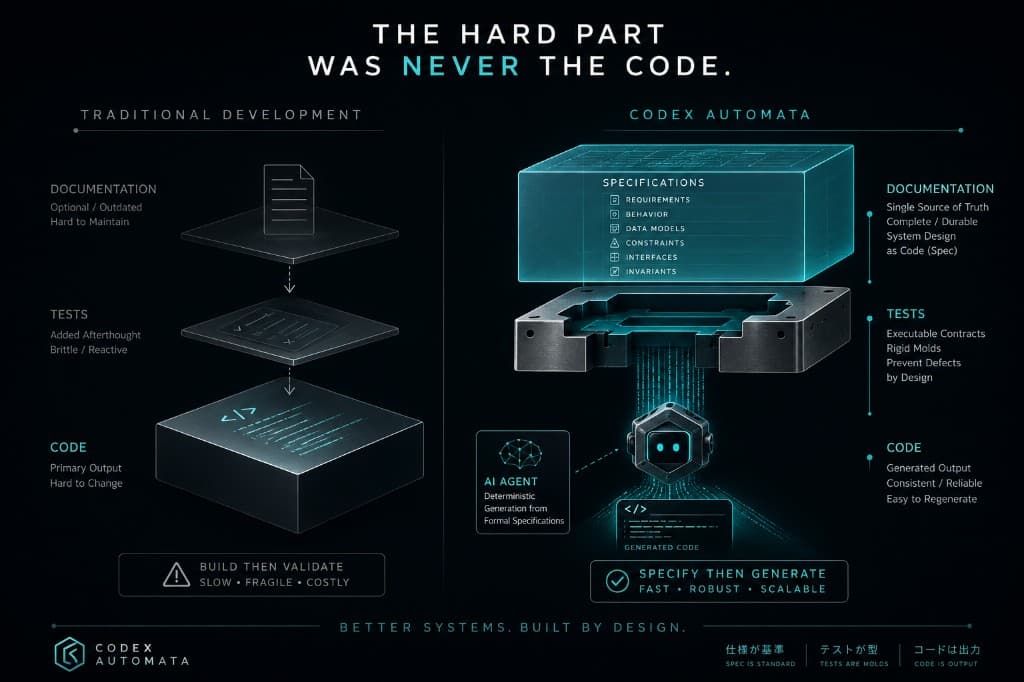
Codex Automata inverts the pipeline. The traditional sequence runs Code, then Tests, then Documentation, with docs treated as an afterthought and frequently abandoned. We reverse it entirely.
Documentation, SDK, Tests, Code
Documentation comes first. Before a single line of implementation exists, the system is specified. Its architecture, its interfaces, its data models, its failure modes, its edge cases. The specification is the primary engineering artifact. It is the thing that took real thought to produce.
The SDK comes second. Derived from the specification, it expresses the architecture as compilable, importable building blocks. Types, interfaces, contracts, extension points. The SDK is the constraint surface, the programmatic boundary that determines what shapes are even possible downstream. Nothing that tests or code do can escape its edges.
Tests come third. Derived from the specification and written against the SDK, they define the exact shape the code must take. Every behavior in the spec has a corresponding assertion. Every edge case has a corresponding test. The tests are precise, rigid, and complete. They are the mold.
Code comes last. An agent, or many agents working in parallel, receives the spec, the SDK, and the tests and writes implementation until every test passes. The code is a casting, a commodity artifact produced by pouring implementation into a prebuilt mold, constrained to the building blocks the SDK provides.
The economics of the moment demand this sequence. When code is cheap and specification is expensive, you optimize for specification. You put your best people, your deepest thinking, and your most rigorous process on the thing that is hardest to get right. Then you let machines handle the rest.
The hard part has always been the documentation.
II. The Mold
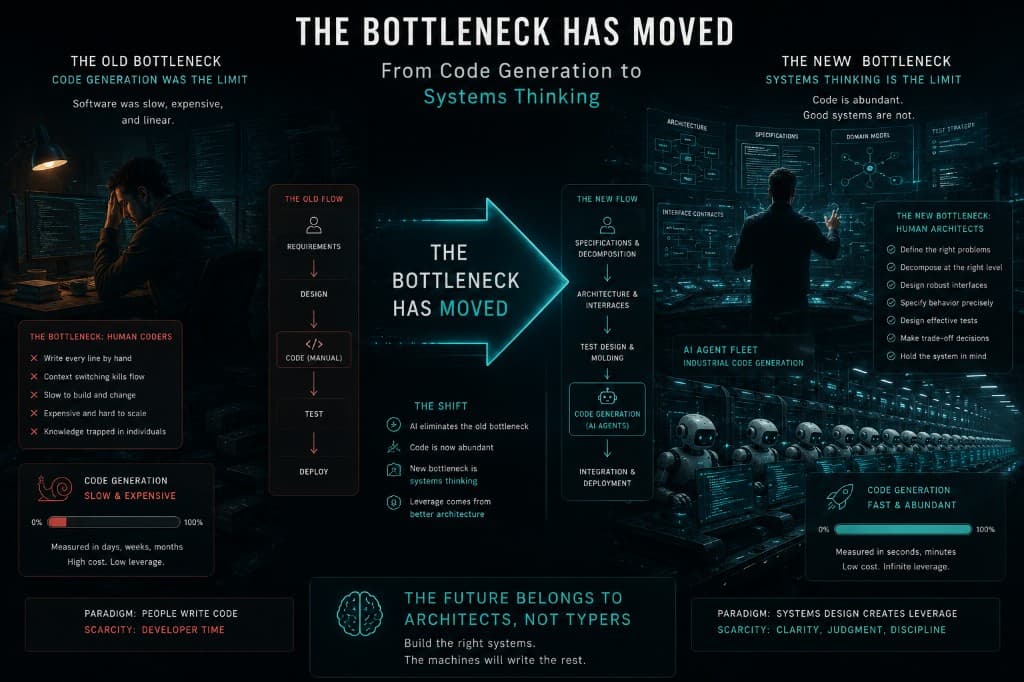
In industrial manufacturing, there is a clean separation between tooling and production. The mold is expensive. It is engineered with precision, machined to tight tolerances, tested and inspected before a single part is produced. The casting, the actual product, is cheap and repeatable. You pour metal into the mold, and the shape is predetermined. If the casting is defective, you do not blame the metal. You fix the mold.
This separation is the correct mental model for software in the agentic era.
Tests are the mold. Code is the casting.
This sounds like test driven development, and it shares DNA with Kent Beck's original insight. Write the test first, let failure guide design. Codex Automata takes it further. TDD, as commonly practiced, is a feedback loop between a developer writing a test and the same developer writing the code that passes it. It is a conversation a person has with themselves. The test and the code evolve together, often in the same session, shaped by the same mind's biases and blind spots.
When agents write the code, the dynamic changes completely. The test becomes a rigid constraint. It is a precise specification of acceptable behavior that a machine must satisfy. The test does not evolve with the code. The test stands firm, and the code must conform.
This distinction matters because it changes what tests need to be. In traditional TDD, a test can be somewhat loose. It captures the developer's intent well enough because the developer is also the implementer. In Codex Automata, tests must be sharp. They must overconstrain the solution space where behavior matters and leave freedom only where freedom is deliberate.
Without tests, an agent generates infinite variety. It can produce a dozen implementations of the same spec, each plausible, each slightly different, with no way to determine which is correct. The agent is simply unconstrained. Feed it a sharp mold, and the output snaps into a specific shape. The mold transforms code generation from an open ended creative act into a bounded search problem. Find an implementation such that all assertions pass.
Better constraints produce better results, faster.
It is important to remember that Toyota understood this fifty years ago. The Toyota Production System draws a hard line between process preparation and production execution. Enormous effort goes into designing jigs, fixtures, and tooling, the equivalent of our tests and specs. Production itself is fast, repeatable, and largely automated. When a defect appears on the line, the response is to fix the tooling, not tinker with the product. The concept of jidoka, stopping the line when quality fails, maps directly to CI/CD quality gates that halt promotion until the mold is corrected.
The implication for software teams is stark. The engineering lives in the mold. Your best engineers should be spending their time designing molds, writing specifications, deriving test cases, and thinking through edge cases. Implementation code that a machine can produce in seconds is no longer where the real work lives.
If code is wrong, do not debug the implementation. Fix the spec. Fix the tests. Recast.
III. The Constraint Surface
There is a gap between a specification and a test suite that traditional methodologies leave implicit. The specification says what the system must do. The tests assert that specific behaviors hold. But neither one constrains how agents structure their work. An agent given a spec and told to write tests can invent any internal architecture it likes: novel abstractions, ad hoc helper layers, bespoke patterns that vary from module to module. The tests pass, but the system is incoherent. Every module is a snowflake. Integration becomes archaeology.
The missing layer is the SDK.
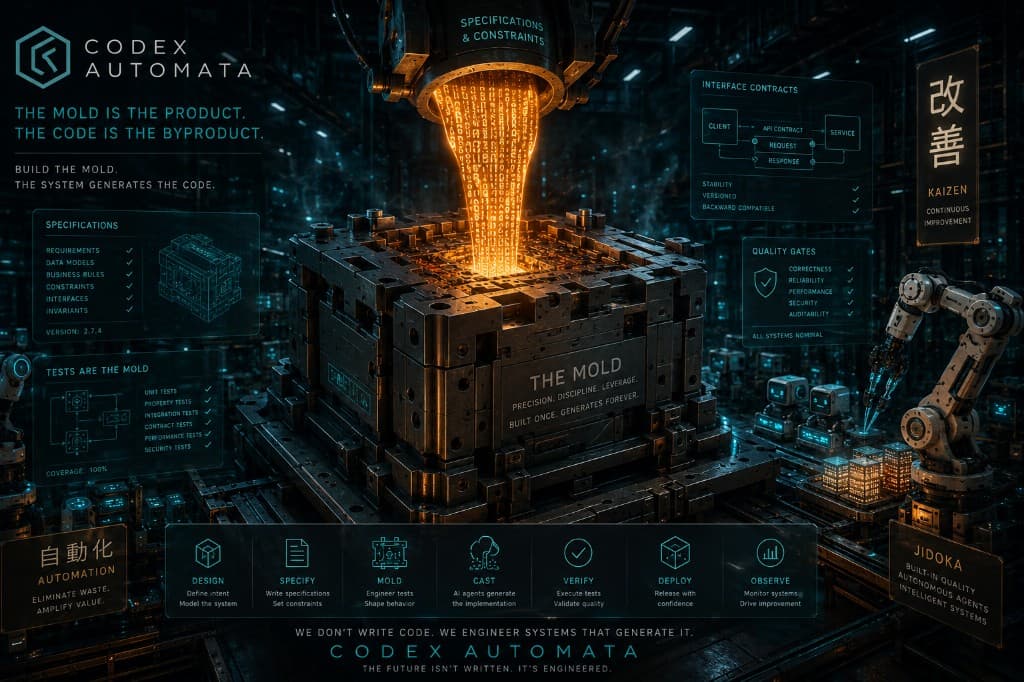
The SDK is the constraint surface. It is the programmatic expression of architectural decisions, rendered as compilable code before tests or implementation exist.
In manufacturing, before the mold is cut, the tooling system is designed. Jigs, fixtures, standard interfaces between stations. These do not produce parts directly. They constrain what parts are possible. A fixture determines the orientation of every piece that passes through it. A standard interface ensures that every subassembly connects the same way. The tooling system is not the product. It is the grammar the product must speak.
The SDK serves the same function for software. It defines the types, interfaces, extension points, and compositional primitives that all downstream work must use. When an agent writes tests, it writes them against SDK interfaces. When an agent writes implementation, it implements SDK contracts. The agent cannot invent new abstractions outside the SDK's vocabulary because the type system will not compile. Constraint is enforced mechanically, not by instruction.
This is the critical insight for the agentic era. When code generation is cheap, the primary control mechanism is constraint. You do not control an agent by telling it what to do. You control it by defining what it is allowed to do. The SDK is that definition. It is the boundary between infinite possibility and bounded, coherent output.
The pipeline becomes: Documentation, SDK, Tests, Code.
The specification defines what the system must do. The SDK defines the building blocks available to do it. Tests assert that specific compositions of those blocks produce correct behavior. Code fills in the implementations behind the SDK's interfaces. Each layer constrains the next. Each layer is more concrete than the last. By the time an agent writes implementation, the solution space has been narrowed from infinite to tractable.
This forces a level-up in abstraction that has profound consequences. When you must express your architecture as an SDK before any test or implementation exists, you are forced to think in modular building blocks. You cannot design a tangled monolith and express it as an SDK. The very act of defining importable interfaces, composable types, and extension points requires clean decomposition. The SDK makes modularity a structural requirement, not an aspiration.
Consider what happens without this layer. An agent receives a spec for a payment processing module. It writes tests. It writes code. The code works. A second agent receives a spec for an invoicing module. It also writes tests and code. Both pass their respective molds. But when integrated, the two modules represent money differently, handle errors through incompatible patterns, and use conflicting concurrency models. They are individually correct and collectively incoherent. The problem is not missing tests. The problem is missing constraint. No shared vocabulary was enforced at the code level.
With an SDK, both agents import the same Money type, implement the same PaymentProvider interface, use the same Result pattern for errors, and compose through the same event primitives. Coherence is not negotiated after the fact. It is predetermined by the constraint surface.
The SDK also solves the extension problem cleanly. As the application grows, new capabilities are needed that the initial SDK does not provide. The response is not to work around the SDK or to let agents invent ad hoc solutions. The response is to return to the specification, define the new capability, extend the SDK with the new building block, then derive tests and implementation against the expanded surface. The pipeline runs forward again from the point of change. Extension is disciplined, not emergent.
This mirrors how mature platform companies operate. Stripe does not let every team invent its own API patterns. AWS does not let every service define its own error model. They build SDKs, internal and external, that enforce consistency across hundreds of teams and thousands of services. The SDK is the mechanism by which architectural decisions survive contact with scale. In the agentic era, the same logic applies to AI agents. The SDK is how architectural intent survives contact with a fleet of code-generating machines that have no taste, no memory, and no loyalty to coherence.
The constraint surface is not overhead. It is the thing that makes everything downstream predictable, composable, and correct by construction.
IV. Local-First
There is a seductive trap in the agentic era. Frontier models are powerful. They hold vast context windows, tolerate sloppy prompts, compensate for ambiguous instructions, and produce impressive results despite undisciplined inputs. The temptation is to build for frontier first, to assume unlimited context, infinite reasoning budget, and perfect instruction following, then worry about efficiency later.
This is the same mistake the industry made with code for decades. Build it first, optimize later. It produces systems that are structurally dependent on expensive infrastructure, brittle when conditions change, and impossible to scale down without a rewrite.
Codex Automata inverts this. Build local-first. Expand to frontier as needed.
A system designed to run on the smallest viable model will run better on every larger model. The reverse is never true.
The reasoning is structural. A local model has severe constraints. Limited context window. Weaker reasoning. Less tolerance for ambiguity. Slower inference. No room for bloated prompts or vague instructions. A system designed to function within these constraints must, by necessity, practice every discipline that makes AI engineering robust.
Context management becomes mandatory. When the context window is small, every token matters. Specifications must be precise and modular, not because it is philosophically elegant, but because a local model cannot hold a fifty-page spec in memory. The system must retrieve the right fragment of specification at the right moment, which means specifications must be indexed, chunked, and cross-referenced with surgical precision. This is good engineering forced into existence by constraint.
Prompt discipline becomes mandatory. A frontier model will produce reasonable output from a rambling, contradictory, three-thousand-token prompt. A local model will not. Building local-first forces prompts to be tight, structured, unambiguous, and minimal. Every instruction must earn its place. Every system message must carry information density that justifies its token cost. The result is a system that communicates with machines the way good specifications communicate with humans: precisely, without waste.
Task decomposition becomes mandatory. A frontier model can hold an entire module in its context and reason about the whole thing at once. A local model cannot. Building local-first forces tasks to be atomized into units small enough for a constrained model to complete successfully. This is exactly the modularity and atomization that Codex Automata already demands, but local-first makes it a hard technical requirement rather than a process aspiration. If the task does not fit in the window, it is too large.
Error handling becomes mandatory. Frontier models fail rarely and gracefully. Local models fail more often and less predictably. Building local-first forces the system to handle partial completions, retries, validation of outputs, and graceful degradation from the beginning. The infrastructure for reliability exists before it is needed at scale, because it was needed at small scale first.
The economics reinforce the principle. Local models are cheap. They run on commodity hardware. They incur no API costs, no rate limits, no vendor dependencies. A system proven on local models can scale to frontier when the task genuinely demands it, with confidence that the system's architecture does not depend on frontier capabilities as a crutch.
The expansion path is clean. Start with the smallest model that can complete the task given perfect inputs. Verify. Then relax constraints as you move to larger models: larger context windows allow fewer retrieval calls, stronger reasoning allows less prescriptive prompts, faster inference allows more ambitious single-pass generation. Each relaxation is a measured decision with a known baseline, not a dependency discovered in production when the API bill arrives or the rate limit triggers.
This mirrors how serious engineering has always worked in constrained domains. Embedded systems engineers do not prototype on a server and then figure out how to fit it on a microcontroller. They design for the microcontroller first. The constraints force architectural decisions that produce efficient, reliable, well-structured systems. Then when they move to a more powerful chip, the system runs better, not differently.
The inverse path, building for frontier and then trying to compress, produces systems that are architecturally dependent on capabilities they should never have assumed. Long prompts that cannot be shortened without losing critical context. Monolithic tasks that cannot be decomposed without redesigning the workflow. Implicit reliance on reasoning capabilities that smaller models lack. The system works beautifully on GPT-5 and collapses on anything less. That is not engineering. That is luck that has not yet expired.
Local-first is not a performance optimization. It is an engineering discipline. It forces the practices that make AI systems robust, portable, cost-efficient, and architecturally sound. Build for the smallest viable model. Let constraint be the teacher. Expand to frontier when you have earned the right by proving the architecture does not need it.
V. Research as Foundation
There is a practice that every competent engineer performs informally and that no methodology has ever formalized as a first-class phase: research.
Before writing a specification, a good engineer investigates. What solutions exist? What technologies have others used for this problem? What are the current best practices, the known pitfalls, the libraries that have matured, the approaches that have been tried and abandoned? This investigation has always happened, but it happened in the engineer's head, in browser tabs closed and forgotten, in Slack messages lost to scroll. It was invisible work that produced no artifact and left no trace in the project record.
In the agentic era, this invisible work becomes visible, parallelizable, and systematic. AI agents can research technologies, compare implementations, survey market solutions, analyze trade-offs, and synthesize findings with a thoroughness and speed that no individual human can match. A single agent can review fifty open-source libraries in the time it takes a human to evaluate three. A fleet of agents can survey an entire ecosystem, cross-reference documentation, examine real-world usage patterns, and produce a structured comparison that would take a human team weeks.
This capability demands formalization. Research is not a preliminary activity that happens before the methodology begins. It is the methodology's first act.
Every specification should be informed by structured research. Every architectural decision should reference the landscape it inhabits.
The traditional approach to technology decisions in software teams is tribal knowledge combined with individual experience. The senior engineer recommends PostgreSQL because she has used it successfully for a decade. The team adopts React because the last project used it. The messaging system is Kafka because someone read a blog post. These decisions are not wrong, but they are uninvestigated. They carry hidden assumptions about the problem space that were never validated against the current state of available solutions.
Agentic research changes this. Before specifying a persistence layer, an agent surveys the current database landscape: performance characteristics, scaling limits, operational complexity, community health, licensing, compatibility with the existing stack, migration patterns from competitors, recent postmortems from production users. Before specifying an API design, an agent examines how comparable systems expose their capabilities: what conventions have emerged, what mistakes are commonly reported, what patterns have proven durable at scale. Before specifying an authentication flow, an agent reviews current security advisories, recent breach analyses, protocol updates, and library maturity across the target ecosystem.
This is not premature optimization or analysis paralysis. It is due diligence made cheap. When research costs hours of human attention, shortcuts are rational. When research costs minutes of agent computation, shortcuts are negligent. The economics have changed. The excuse for uninvestigated decisions has evaporated.
The research phase produces artifacts. Technology landscape documents. Comparison matrices. Trade-off analyses. Risk assessments grounded in real-world evidence rather than intuition. These artifacts become inputs to the specification phase, where humans make informed decisions rather than habitual ones. The specification references its research. Architectural decision records cite the landscape analysis that informed them. The chain of reasoning from investigation to decision to specification to implementation is traceable.
This also changes how specifications handle novelty. When a specification encounters a problem the team has not solved before, the traditional response is either to guess, to copy what a competitor appears to have done, or to defer the decision until someone has time to investigate. The Codex Automata response is to dispatch research as a formal task. The agent produces a structured finding. The human decides based on evidence. The specification captures the decision with its rationale anchored to current reality.
Research is not a one-time event at project inception. It recurs throughout the lifecycle. When a dependency publishes a breaking change, research evaluates migration paths. When a performance bottleneck appears, research surveys optimization techniques proven in comparable systems. When a security vulnerability is disclosed, research assesses exposure and patches across the ecosystem. The research capability is always available, always current, and always cheaper than ignorance.
The implication for the pipeline is concrete. Research precedes specification. It may run in parallel with architecture decomposition. Its outputs feed directly into specifications and ADRs. Agents perform the investigation; humans perform the judgment. The agent reports what exists. The human decides what to use.
Build on investigated ground. Let agents survey the landscape. Make decisions with evidence, not habit.
VI. The Anatomy of Good Work
There is a reason Unix conquered the world and the alternatives did not.
In the late 1960s, Ken Thompson and Dennis Ritchie at Bell Labs made a design choice that seemed, at the time, almost trivially obvious. Programs should do one thing well. They should communicate through simple, text based interfaces. They should compose through pipes. The result was an ecosystem of small, sharp tools that could be combined in ways their creators never anticipated. grep does not know about sort. sort does not know about uniq. But grep pattern file | sort | uniq -c does something none of them could do alone, and it does it reliably because each piece has one job and clear boundaries.
This is an engineering law. Small, independent components compose. Large, entangled components do not. The reason is mathematical. As a system grows, the number of potential interactions between its parts grows combinatorially. A system of ten tightly coupled components has 45 pairwise interactions. A system of one hundred has 4,950. Tight coupling makes each interaction a potential failure mode, a coordination burden, and a communication channel that must be maintained.
Loose coupling with clean interfaces collapses this explosion. Each component interacts with a small, stable surface area. Adding a new component does not require understanding all existing components, only the interfaces it touches.
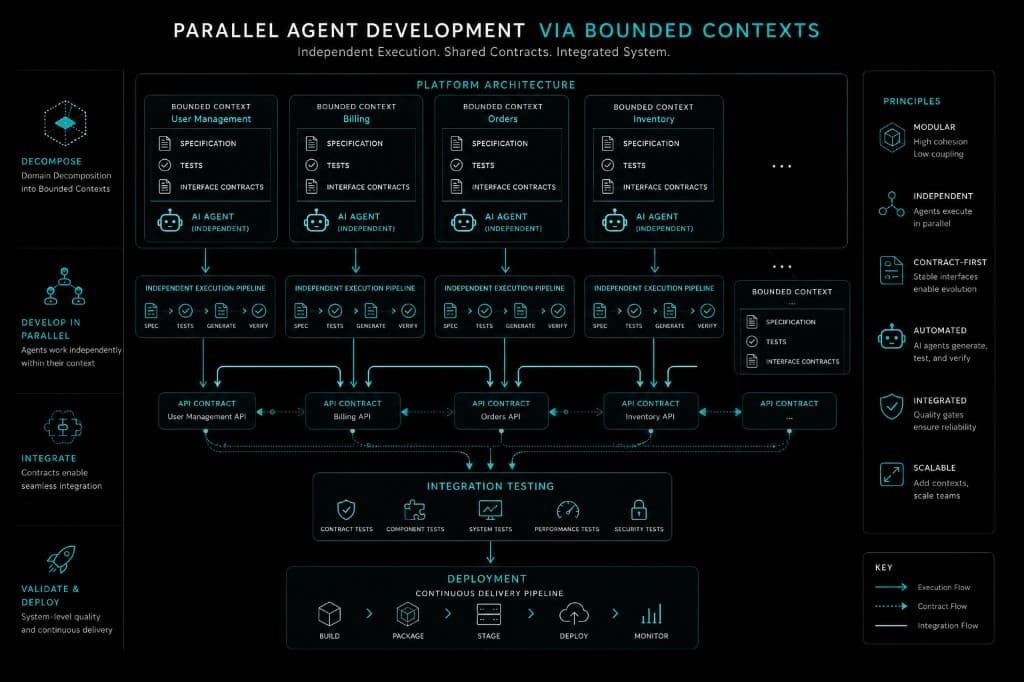
Eric Evans formalized this insight for software systems with Domain Driven Design. His bounded contexts are a pragmatic answer to a difficult question. How do you partition a complex domain so that each partition can be understood, built, and maintained independently? The answer is to draw boundaries where the domain model changes meaning, where the same word means different things to different parts of the system. Each bounded context gets its own language, its own model, its own truth.
In the agentic era, bounded contexts serve a second purpose that Evans could not have anticipated. They are the natural unit of parallel execution. Each bounded context can receive its own spec, its own tests, and its own agent. The agents do not need to communicate with each other because the boundaries ensure independence. The interfaces between contexts are defined in contracts, frozen before code exists, and verified by integration tests after the cast.
This is the insight that makes parallelization work. Modularity is the prerequisite for agentic development. Without clean boundaries, you cannot parallelize. Without parallelization, you are running agents sequentially, which means you have expensive infrastructure reproducing the same bottleneck you had with human developers. In this way you have changed nothing.
The corollary is equally important. Atomization is about making things small enough to be independently completable. A task that can be picked up by an agent, executed to completion against its own tests, and merged without coordinating with other agents, that is an atom. A task that requires mid flight coordination between agents, that is a molecule, and it will slow you down.
Brooks proved in 1975 that adding people to a late project makes it later. His reasoning was precise. Communication overhead scales with the square of the team size. Ten people generate 45 communication channels. A hundred generate 4,950. The project drowns in coordination.
Brooks was solving for the wrong variable. He assumed that every worker needs to communicate with every other worker. That is true when the specification is incomplete or ambiguous, when workers need to negotiate intent, resolve contradictions, and align on meaning in real time. It is false when the specification is complete. Ten agents reading the same spec create zero communication channels. A hundred agents reading the same spec still create zero communication channels. The spec is the communication. Brooks' Law holds for humans precisely because humans cannot perfectly externalize their mental models into shared documents. Codex Automata's entire philosophy is an attack on that limitation. Externalize everything into specs and tests, and the coordination cost approaches zero.
The implication is uncomfortable for engineers who take pride in writing code. The most valuable work you can do is decomposition. Carving a system into modules with clean interfaces, sharp specs, and comprehensive tests. That is the work that unlocks everything else. The implementation is what happens after the real engineering is done.
VII. The Economics of Forward
There is a deeply held instinct in software engineering that says build the minimal thing first. Start with a prototype. Get it working, then make it scale. Premature optimization is the root of all evil. Ship the simplest thing that could possibly work.
This instinct was correct when writing code was expensive. If generating a hundred lines of code cost an hour of human effort, you wanted to generate as few lines as possible. You optimized for minimal output. Build the small version, see if it works, then invest in the larger version only if the market demands it. The cost of code was the binding constraint.
When code generation costs near zero, the calculation inverts. The cost of generating scalable code is now negligible. The cost of retrofitting scalability into a tightly optimized minimal system is enormous. It requires rewriting specs, rewriting tests, rewriting interfaces, and recasting the entire module. You pay the full cost of the Codex Automata pipeline again, not because you are building something new, but because you are rebuilding something you already built wrong.
In the agentic era, the efficient strategy is to build at scale first and optimize later.
It is important to note that this is a recognition that the default should be generality, abstractions that accommodate growth, interfaces that anticipate extension, data models that handle volume, because the marginal cost of generating that generality is near zero, and the cost of not having it when you need it is a full architecture rework.
Google's engineering culture has operated this way for decades, though for different reasons. Monorepo practices, shared infrastructure, and aggressive standardization mean that every new service at Google inherits scalability patterns from day one. The reason is practical. Retrofitting it later is more expensive than including it from the start. SRE's error budgets are design constraints, not operational afterthoughts. The acceptable failure rate is specified before the service is built, and the architecture is designed to meet that target.
In Codex Automata, the same logic applies at the individual project level. You specify performance requirements in the spec. You write tests against those requirements. You build the pipeline with performance benchmarks from day one. The agent generates code that meets those constraints from the first cast. If profiling later reveals that certain paths are overprovisioned, you tighten, armed with data rather than intuition. Optimization becomes an evidence driven refinement activity instead of a frantic scramble when the system falls over under load.
The traditional scaling path, build minimal then rewrite, made sense when rewrites were cheaper than upfront investment. In the agentic era, upfront investment in specification is cheap and rewrites are expensive. The economics point forward.
VIII. The Flow
Scrum was designed for humans. Its core assumptions are biological.
Sprints assume that workers fatigue over a two week cycle and need a reset boundary. They assume that estimation is meaningful because the same humans will do the work they estimated. They assume that velocity stabilizes because teams learn and improve at a roughly steady pace. They assume that daily standups are necessary because humans forget context overnight and need synchronization rituals. They assume that retrospectives are necessary because humans do not naturally reflect on process without structured prompts.
None of these assumptions apply to AI agents. Agents do not fatigue. They do not estimate. They execute or they fail. Their velocity is a function of task complexity and model capability, not available hours. They do not lose context overnight. They do not need standups.
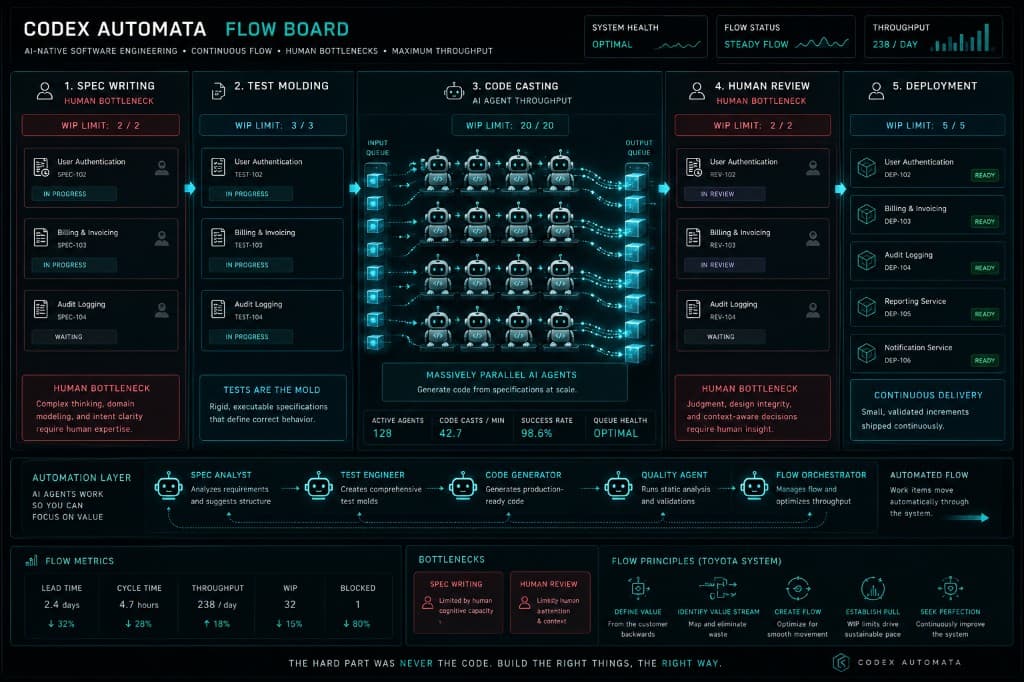
What agents need is a steady flow of well specified work, clear completion criteria, and automated quality gates. That is kanban.
Toyota's manufacturing philosophy never used sprints. It used continuous flow with pull based scheduling and work in progress limits. When a downstream station finishes processing a part, it pulls the next part from the upstream buffer. Nothing is pushed forward until the downstream station signals readiness. WIP limits prevent any station from accumulating inventory that exceeds its processing capacity. The result is smooth, predictable throughput with minimal waste.
This maps to agentic development with almost no translation needed.
The Spec Writing station produces specifications. It has a WIP limit, typically small because humans are the bottleneck here, and work only proceeds when a spec meets its exit criteria.
The SDK Design station consumes specs and produces the constraint surface: types, interfaces, and building blocks that downstream stations must use. WIP is limited because SDK design requires architectural judgment, but the station often runs in parallel with spec writing as the architecture crystallizes.
The Test Molding station consumes specs and the SDK, producing tests written against SDK interfaces. Multiple agents can work this station in parallel, but a WIP limit prevents an avalanche of untested specs from piling up.
The Code Casting station has no WIP limit. This is where parallelism lives. Every module with a complete mold can be cast simultaneously. Ten modules, ten agents, one afternoon.
The Review station has a WIP limit again. Human attention is finite. This is the second bottleneck, and the board makes it visible.
At this point one is likely wondering where the bottleneck actually lives in this system. The bottleneck is never Code Casting. It is always Spec Writing or Review. The board makes this obvious. If specs are piling up in the Backlog and Code Casting is empty, the system is starved of specification. If Code Casting output is piling up before Review, the system is starved of human attention. The board does not just track progress. It diagnoses the system.
CI/CD is the scaffolding that makes the entire flow work. The pipeline exists before the first line of code is written, configured during the Architecture phase alongside specs and interface contracts. It is as foundational as the rebar in a concrete building. Invisible in the finished product, essential to its structural integrity.
Quality gates in the pipeline encode the Codex Automata process itself. Does the code lint? Does every module have a spec? Does every spec have tests? Does the change respect module boundaries? Is the commit atomic? The pipeline enforces the process mechanically so that discipline does not depend on memory or willpower.
IX. The Machine
Picture the system running at full speed.
An engineer receives a feature request. She opens a conversation, with an agent, with the codebase, with the domain. What are the boundaries? What contracts will change? Where will the new behavior touch existing modules? The agent maps the terrain. The engineer supplies judgment. The output is a set of atomic work items, each with sharp boundaries, each independently completable.
She writes the spec. This is the hardest hour of her day. The difficulty is in the thinking. What should the system do at the boundary? What happens when the network drops mid transaction? What does "success" mean, precisely, in terms a machine can verify? The spec is challenged, revised, and frozen. It is the primary artifact, the thing that took real thought to produce.
The SDK takes shape. Types, interfaces, extension points, compositional primitives. The constraint surface compiles. It expresses the architecture as importable building blocks that every downstream agent must use. The vocabulary is fixed before a single test is written.
An agent reads each spec and builds the mold against the SDK. Unit tests, integration tests, contract tests. The tests compile against SDK interfaces. Every one fails. No implementation exists yet. The mold is ready.
Then the cast. Five modules. Five agents. Each receives its spec, its tests, and the interface contracts of its neighbors. They work in parallel, independently, silently. They do not communicate because they do not need to. The specs and contracts contain everything. One finishes in minutes. Another takes an hour. They are not synchronized. When each agent's tests pass, the module is done.
Automated gates fire. An agent reviews against the spec. A human reviews last, checking for coherence. Does the system still make sense as a whole?
But one verification layer remains. The modules pass their tests. The contracts hold. The code is correct. Is the product any good? A system can satisfy every unit test and still be unusable. The signup flow requires twelve clicks when three would suffice. The error message is technically accurate but incomprehensible. The navigation makes sense to the engineer who built it but bewilders the customer who needs it.
Traditional testing cannot catch this. Scripted end to end tests verify a predetermined path: click this button, assert this text. They confirm the path works, not that a user can find it. Agentic product testing inverts the approach. Give an agent a user profile and an objective. "As a first time visitor, create an account and reach the dashboard." The agent navigates the application the way a real user would, reading labels, clicking buttons, making mistakes, recovering from errors. If it cannot accomplish the objective, the product has a usability defect. If it takes twenty clicks when the budget is eight, the product has a friction defect. The agent's journey is measurable evidence of experience quality.
This is a capability that exists only in the agentic era. No previous testing methodology could instruct a test to "figure out how to accomplish this goal" and then measure whether the experience was efficient, discoverable, and humane. Click counts, backtracking rates, dead ends, hesitation points, error recovery paths: these become quantitative signals derived from agents operating the product exactly as users would. The specification defines what the product must do. Product testing verifies that real people can actually do it.
The pipeline runs. The code deploys. Monitoring confirms that production matches the spec. If it does not, the cycle restarts at the mold.
Remove any piece and the machine breaks. Without research, decisions are uninvestigated and specifications encode assumptions instead of evidence. Without specs, agents hallucinate, producing plausible code aimed at the wrong problem. Without the SDK, agents invent incompatible architectures that cannot integrate. Without local-first discipline, the system becomes structurally dependent on expensive frontier models and collapses when conditions change. Without tests, infinite variety with no definition of correct. Without modularity, agents collide in merge conflicts, contradictions, and chaos. Without flow, work pools in the wrong places. Without CI/CD, the whole arrangement depends on discipline that humans will eventually forget and agents will never have.
The principles are load bearing members in a single structure, and each assumes the others are present. Research informs decisions. Specification creates the foundation. The SDK constrains the vocabulary. Local-first forces engineering discipline. Tests constrain the shape. Modularity enables concurrency. Flow exposes bottlenecks. CI/CD enforces integrity. Intentional divergence gives the product identity. Assembly pressure validates that the parts compose under real conditions. Remove one, and the structure does not degrade gracefully. It collapses.
This is why the methodology is called Codex Automata, the book of self moving things. The specifications, tests, gates, and pipelines form a machine that, once built, moves on its own. Agents fill the mold. The pipeline verifies the casting. The board reveals the flow. Humans design the machine and oversee its operation, but the machine runs.
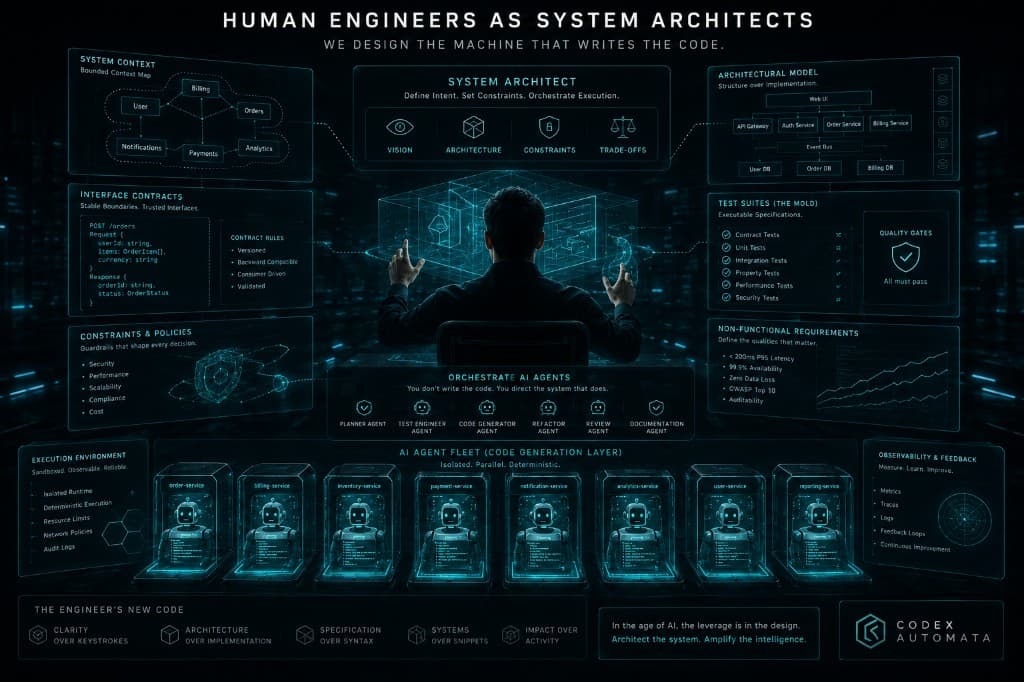
The engineer's job is to build the machine that writes the code correctly.
X. The Identity Problem
There is a failure mode that the machine described above does not catch, and it is visible to every user who encounters the product.
A system can pass every mold, honor every contract, satisfy every quality gate, and still be indistinguishable from every other product built with the same tools. The signup page uses Inter at weight 700. The hero section is a purple-to-blue gradient. The features are arranged in a three-column grid with rounded cards and Lucide icons in tinted circles. The pricing table has a "Most Popular" pill with a gradient border. The copy reads "Unlock the power of..." and "Your all-in-one solution for..." The error messages say "Something went wrong. Please try again later."
This is not a quality problem. It is an identity problem. The product has none.
The cause is structural. AI agents generate output by predicting the most statistically probable tokens given their training data. That training data is heavily skewed toward popular frameworks, starter templates, and the accumulated defaults of tutorial culture. Tailwind's default palette. shadcn/ui's component library. The landing pages of a thousand Y Combinator startups from 2022 to 2024. When an agent receives a vague instruction and no identity constraints, it produces the statistical mode of this corpus. The result is not bad design. It is the average of all design, which is worse than bad design because it is invisible. Bad design at least has character. The average has nothing.
Reinforcement learning from human feedback compounds the problem. Human evaluators rate safe, familiar designs higher than distinctive ones. The model learns to optimize for what looks like every other landing page, because every other landing page scored well in training. Vague prompts like "make it modern" or "clean and professional" map directly to the same cluster of default patterns. The agent is not being lazy. It is being perfectly calibrated to produce mediocrity.
This dynamic is not limited to visual design. It applies to every human-perceptible surface of a product. Copy converges on the same marketing cliches. Naming converges on utils, helpers, service, handler. Error messages converge on the same unhelpful boilerplate. API designs converge on REST with CRUD regardless of whether the domain calls for event sourcing, command patterns, or something else entirely. Architecture converges on the popular stack of the moment regardless of fit. The agent defaults to what it has seen most, not what is right for this specific product.
The solution follows the same pattern Codex Automata applies to every other constraint problem. Specify it. Constrain it. Gate it.
Specification means a design identity document. Before any user-facing casting begins, humans make deliberate choices about what this product looks like, sounds like, and feels like. Not "modern." Not "clean." A specific aesthetic direction with rationale. A specific typography pairing with reasons why these fonts and not the defaults. A specific color system with harmony rules, not the framework's default palette. A specific set of anti-patterns: what this product must never look like, which AI-default patterns are banned for this project. Reference targets: three to five specific products whose aesthetic is the benchmark, not the training-data average.
Constraint means the SDK. Design tokens become building blocks in the constraint surface. Colors, type sizes, spacing, shadows, radii: all named, structured, and importable. Agents use tokens, not raw values. If the token does not exist, the value cannot be used. Copy voice guides and naming registries work the same way. The vocabulary is fixed before casting begins, and the vocabulary is intentional.
Gating means divergence detection. Quality gates check for known AI-default patterns the way they check for failing tests or contract violations. A divergence gate catalogs slop fingerprints: Inter as body font, indigo-600 as accent, three-column feature grids at identical breakpoints, "Unlock the power of..." as headline copy. When a casting matches cataloged fingerprints, the gate flags it for human review. The gate does not judge aesthetics. It detects convergence toward the training-data mean, which is a measurable, objective signal.
The economics are the same as every other Codex Automata principle. The cost of specifying identity is near zero when specification is what humans already do in this methodology. The cost of not specifying it is a product that looks, sounds, and feels like every other product built by the same models. In a market where every competitor has access to the same AI, the products that stand out are the ones whose humans made deliberate choices about identity and encoded those choices as constraints that agents cannot override.
There is a subtler form of convergence that extends beyond what users see. Code structure itself regresses toward the training-data mean. Over-abstraction, redundant service layers, cargo-cult design patterns applied without the problem they solve, speculative error handling for impossible edge cases, filler documentation that restates what the code already says. These are not incorrect. They are average. They sit at the bell curve center of all code the model has seen. In the agentic era, "good" is trivially achievable. The differentiator is statistical divergence from the mean: being on the higher side of the distribution through deliberate engineering choices, deeper research, and rigorous application of principles that push every output, code included, away from the most probable tokens.
Identity is not decoration. It is specification. Specify it, constrain it, gate it. And the principle applies to every output surface, not only the ones users see.
XI. The Alpha Loop
There is one more failure mode that the machine as described does not address, and it is arguably the most expensive one.
Every building block passes its mold. Every contract holds at its boundary. Every divergence gate confirms identity. The code is reviewed, approved, and correct. Then the blocks are assembled into a running system for the first time, and nothing works the way anyone expected.
Performance cliffs appear when three individually correct modules interact in ways no unit test anticipated. User journeys that traverse multiple bounded contexts produce friction that no single module's product test could detect. Data consistency assumptions that held in isolation fail when realistic volume and timing combine. The system is correct in parts and broken as a whole.
This failure mode existed before the agentic era, but the economics were different. When a human spent a week writing a module, pressure-testing the assembly after every module was prohibitively expensive. Teams accumulated unvalidated increments and discovered integration failures late, when context had evaporated and correction cost was highest. The cost structure made late assembly testing a rational, if painful, tradeoff.
The agentic era inverts that cost structure. Agents cast a module in minutes. Assembly can be exercised after every increment. The constraint that made late integration testing rational has disappeared, but the practice persists by inertia.
Assembly Pressure is the principle that replaces it. After each meaningful cast increment, the running system is exercised under realistic conditions. Not once before deployment. Continuously throughout the buildout.
The loop is simple. Cast a building block. Assemble it into the running system. Apply realistic pressure: real data volumes, real user journeys, real failure conditions, real concurrent load. Learn what breaks. Feed the discoveries back to specifications, SDK, or molds. Cast the next block. The system is always runnable, always under pressure, always generating feedback.
This is the highest-leverage engineering activity in the agentic era. Not writing the code, which is trivially cheap. Not writing the spec, which is amortized across many casts. Subjecting the assembled system to conditions that expose integration failures early, while the cost of correction is low and the context of the original decisions is still fresh.
The principle complements Phase 6b Product Testing but is distinct from it. Product Testing is a formal verification gate before deployment. Assembly Pressure is an incremental feedback loop during development. Product Testing asks "does the assembled product meet UX budgets?" Assembly Pressure asks "does the assembly even hold together under realistic conditions?" Product Testing runs against a finished assembly. Assembly Pressure runs against every intermediate assembly as the system grows.
XII. The Fracture Lines
Every methodology has a domain where it excels and a boundary where it breaks. Codex Automata is no different. Intellectual honesty requires mapping the fractures.
(Note: the creative design exploration described below, where a designer prototypes interactions in code as a sketching medium, is distinct from the identity problem. Creative exploration is how design decisions are discovered. Intentional Divergence is how those decisions are encoded as constraints once they crystallize. The two are complementary, not contradictory.)
The methodology assumes that the problem can be specified before it is solved. This is true for the vast majority of production software. CRUD applications, data pipelines, API services, infrastructure tooling, enterprise systems. It is not always true for research. When a physicist is groping toward a new model, or a machine learning researcher is exploring whether an architecture can learn a task at all, the specification and the discovery are the same act. You cannot write tests for a hypothesis you have not yet formed. In these domains, exploratory code is the instrument of thought. Codex Automata applies after the exploration, when the shape of the solution is known and the task is to engineer it reliably.
Similarly, certain creative work resists upfront specification. A designer prototyping an interaction in code is not implementing a spec. She is using code as a sketching medium, where the "specification" is the felt experience of the interface, and it only exists in her judgment after she sees it. Applying rigid test first discipline to this kind of work would strangle it. The correct response is to let creative work be creative, then, once the design crystallizes, specify and test the result for production.
There is also the question of scale. A solo developer building a weekend project does not need a kanban board, formal specs, and CI/CD quality gates. The overhead would exceed the benefit. Codex Automata is designed for systems that matter. Systems that must be correct, must scale, must be maintained by more than one person or agent over time. For a throwaway script, write the script.
The deepest limitation is the cold start problem. Writing good specs requires domain knowledge, architectural taste, and the hard won intuition that comes from years of building systems that failed. You cannot spec what you do not understand. Junior engineers cannot be dropped into the Spec Writing station and expected to produce sharp molds. They must first learn what good looks like, which means, paradoxically, they may need to write bad code, debug it, and internalize the failure modes before they can specify well. The methodology does not eliminate the need for experience. It concentrates experience where it matters most.
There is one more fracture line, subtler than the others because it lives inside the methodology itself. The pipeline assumes that specifications and tests are written before code. In practice, even disciplined teams discover gaps after the fact. A production incident reveals a failure mode that no one specified. A coverage audit exposes a module with tests that were disabled months ago and never restored. A new engineer walks through the codebase and finds behavior that exists in code but in no specification anywhere.
The instinct in these moments is to fix the immediate problem. Add a test for the failure mode. Re-enable the disabled tests. Move on. This instinct is dangerous because it inverts the pipeline. A test written to match existing code is not a mold. It is a tracing. It encodes whatever the code happens to do, correct or not, and calls it specified. The gap in the specification remains, invisible but load bearing.
The correct response is the same response the methodology prescribes for forward work, applied in reverse. When a gap is discovered, trace it back to its root. If the specification is missing, write it. If the specification exists but the mold does not, derive the tests. If the mold existed but eroded, restore it from the specification, not from the code. Then verify or recast the implementation against the repaired mold. Recovery follows the pipeline. It simply enters at a different point.
This matters because recovery is not an exception. It is a permanent feature of real systems. No methodology eliminates gaps entirely. What a methodology can do is define how gaps are found, classified, and closed with the same discipline that governs forward work. A system that can only build forward is fragile. A system that can also recover is resilient. The mold must be inspected and maintained, not just built once and trusted forever.
None of these limitations invalidate the approach. They define its scope. Codex Automata is a methodology for engineering production systems in an era when implementation is cheap and specification is the binding constraint. Within that scope, it is precise.
XIII. The Engineer, Redefined
If agents write the code, what becomes of the engineer?
The question is understandable. For decades, engineering identity has been bound to implementation. We interview for coding ability. We promote for technical depth. We admire the developer who can hold an entire system in their head and produce elegant, efficient code from raw intent. That skill was genuinely rare and valuable when implementation was the bottleneck. It commanded respect because it was hard.
It is still hard. It is no longer scarce.
The shift is a promotion to the work that was always more important but rarely rewarded proportionally. The engineer who can decompose a complex domain into clean modules with precise contracts has always been more valuable than the engineer who can implement one of those modules quickly. We just could not afford to acknowledge it, because we needed both, and the implementers outnumbered the architects by necessity.
When implementation is automated, the ratio inverts. The scarce, valuable skill becomes defining exactly what a function must do, in what contexts, with what failure modes, at what performance envelope, and proving it with tests before a line of code exists. That is specification. It is a higher order skill than implementation, and it requires everything implementation requires, deep technical knowledge, systems thinking, an internalized model of how software behaves, plus the ability to externalize that knowledge into artifacts precise enough for a machine to act on.
The new engineering skillset is domain modeling, constraint design, interface architecture, and test derivation. It is knowing what questions to ask about a system before building it. It is understanding failure modes well enough to specify them in advance. It is the ability to think in contracts, in invariants, in boundary conditions, and to express that thinking in documentation and tests that leave no room for misinterpretation.
This is harder, more technical work that has always existed but was often skipped because the pressure to ship code pushed engineers past the thinking and into the typing. Codex Automata removes that pressure. When agents handle the typing, engineers can finally do the thinking that the industry has always claimed mattered most but rarely made time for.
The engineer of the agentic era does not write less. She writes differently. Specifications instead of implementations, constraints instead of solutions, molds instead of castings. Her output is more durable, more leveraged, and harder to produce than the code it generates.
Coda
The giants of software engineering, Beck, Brooks, Martin, Evans, Fowler, the engineers at Bell Labs, NASA, Toyota, Google, Stripe, and AWS, spent decades articulating the principles that Codex Automata codifies. Write the test first. Maintain conceptual integrity. Keep components small and composable. Separate concerns. Limit work in progress. Integrate continuously. Specify before you build. Constrain before you test. Design for the weakest link first. Investigate before you decide. Make every choice deliberate.
They were right about all of it. For decades, the industry adopted these principles imperfectly because the discipline they demanded was expensive in human time and attention. It was faster to skip the spec. It was easier to write the test after. It was more exciting to write code than documentation. The principles were honored in conference talks and violated in commit logs.
AI agents do not change the principles. They change the cost of following them. When implementation is handled by machines, the spec becomes the main deliverable. The SDK becomes the enforceable boundary. Tests become the mechanism that makes production reliable. Modularity becomes the structural requirement for running ten agents in parallel. Identity becomes the thing that separates your product from every other product built by the same models. The discipline that engineers could never quite afford is now the thing they cannot afford to skip.
The principles were always right. The economics finally agree.
Build the mold. The rest is casting.
Codex Automata Manifesto v2.0, May 2026
Get the harness on GitHub