Cisco CBRCOR
Cisco Certified Specialist - Cybersecurity Core | Certification Review

Certification at a Glance
Overview
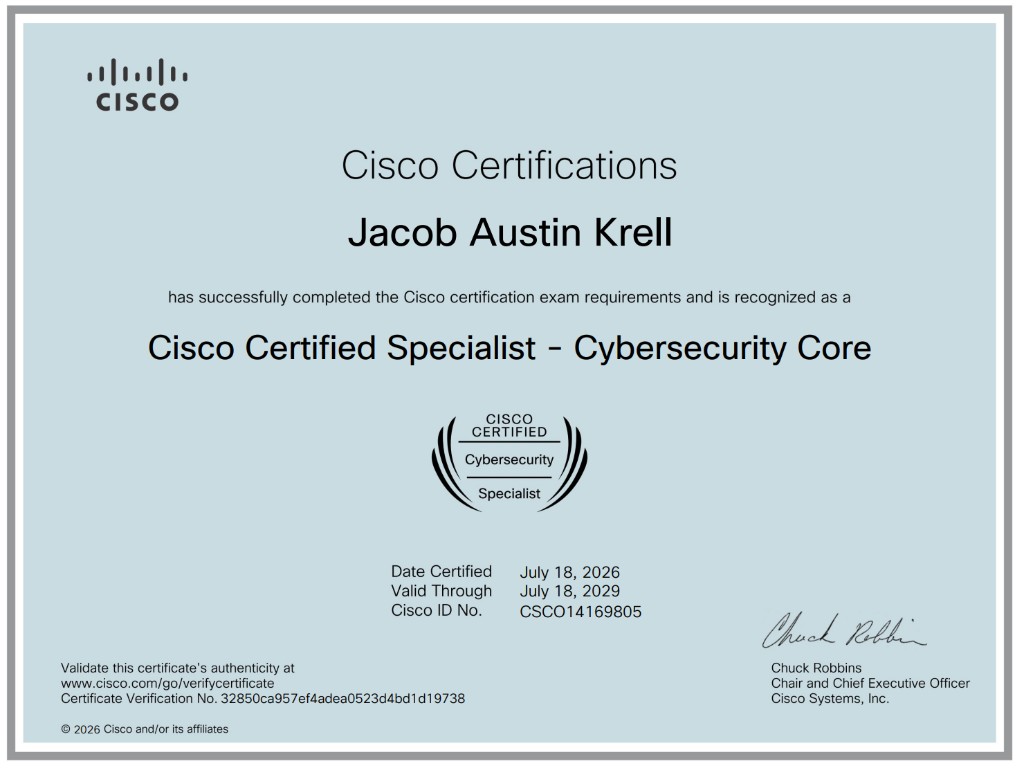
The Cisco 350-201 CBRCOR (Performing Cybersecurity Using Cisco Security Technologies) is the core exam for the CCNP Cybersecurity certification. Passing it earns the Cisco Certified Specialist - Cybersecurity Core credential. The exam covers SOC operations fundamentals, detection techniques, incident response processes, and security automation, and is aimed squarely at analysts, incident responders, and defensive security practitioners.
The single most important thing to know about this exam is that it tests process and methodology, not Cisco products. Despite the name, very little Cisco-specific product knowledge was required. If you understand SOC workflows, incident handling, and threat detection principles, your existing knowledge transfers directly regardless of which vendor stack you work with. The biggest surprise for me was how much Python code interpretation appeared on an exam branded around SOC operations. More on that below.
In my experience, Cisco writes some of the most demanding multiple-choice exams in cybersecurity, and the CBRCOR carries that reputation forward. The questions are scenario-heavy, requiring you to hold several concepts in context and select the best next action. That said, it is still a multiple-choice exam. Compared to any practical, hands-on certification I have taken, it is significantly easier. The difficulty here is relative to other knowledge-based exams, not to labs or live environments.
Who Should Take the CBRCOR?
The CBRCOR is ideal for SOC analysts, incident responders, and defensive security professionals who want a recognized knowledge-level credential that validates analytical reasoning, not just tool familiarity. It pairs especially well with hands-on certifications like HTB CDSA or OffSec OSDA. If you are looking for a certification that proves you can investigate real incidents, start with those instead. The CBRCOR validates the theory and process that underpin the practical work.
Quick Ratings
| Category | Rating |
|---|---|
| Difficulty | 7.5 / 10 |
| Cisco-specific content | 3 / 10 |
| Practical relevance | 7 / 10 |
| Study time (with experience) | ~1 month |
| Value for money ($400) | 7 / 10 |
| Would I recommend? | Yes |
What the CBRCOR Covers
The exam is organized into four weighted domains. Techniques and Processes carry the heaviest weight at 30% each, with Fundamentals and Automation at 20% each.
Fundamentals (20%)
Expect several Zero Trust architecture questions. Understand why micro-segmentation limits lateral movement and how it differs from traditional perimeter defense. You should also know the operational responsibilities that distinguish different SOC service models and be comfortable with cloud platform security considerations. For anyone who has worked in or around a SOC, this domain is the most straightforward of the four.
Techniques (30%)
This is the analytical core of the exam. You need to distinguish between IOCs and IOAs, interpret traffic patterns and event sequences, and understand when to apply packet capture versus log analysis versus UEBA. Know the difference between reactive detection and proactive threat hunting. The questions present realistic SOC scenarios and ask you to choose the correct detection or analysis approach. Make sure you understand the categories of security tools and what each one does, including SIEM, SOAR, UEBA, EDR, NDR, and how they complement each other in a SOC workflow.
Processes (30%)
This was the most challenging domain. The questions focus on incident investigation workflows using SIEM and SOAR platforms, and they demand you know the correct sequence of actions, the right escalation path, and the appropriate response to a given situation. JSON parsing, API authentication mechanisms, and common data formats (XML, CSV, HTML) appeared frequently. This is also where the infamous "best next action" question style was most prominent, and where I found myself genuinely torn between two plausible answers more than once.
Automation (20%)
The automation domain covers when and why to automate, what requires human judgment versus what should be orchestrated, and how playbooks improve SOC efficiency. The questions were more conceptual than technical. For practitioners who have worked with SOAR platforms or built automation workflows, this domain is straightforward.
What Surprised Me
Every good certification review should tell you what the exam blueprint does not make obvious. Here is what caught me off guard:
| Phase | Focus |
|---|---|
| 1. Preparation | Policies, tools, training, playbooks, and team readiness before an incident occurs |
| 2. Detection and Analysis | Identifying indicators of compromise through monitoring and alerting, then triaging alerts, scoping the incident, and determining severity and impact |
| 3. Containment | Isolating affected systems and preventing further spread of the threat |
| 4. Eradication | Removing the threat actor, malware, and persistence mechanisms from the environment |
| 5. Recovery | Restoring affected systems to normal operations and validating integrity |
| 6. Post-Incident | Lessons learned, documentation, process improvement, and updating defenses |
This six-stage model aligns with Cisco's own XDR documentation. NIST SP 800-61 Revision 2 grouped the same activities into four broader phases (combining Containment, Eradication, and Recovery into one). Revision 3, published in 2025, maps incident response across the NIST CSF 2.0 functions. For exam preparation, the six-stage breakdown above is what matters.
How I Studied (No Formal Training)
I did not take a formal training course. Professional experience already covered most of the SOC operations and incident response concepts on the blueprint, which made self-study viable.
My primary tools were ChatGPT and practice tests, following the same approach I used for the IAPP CIPM, feeding the exam objectives into the LLM, having it teach each domain systematically, then use practice tests as gap analysis. For every question I got wrong or felt uncertain about, I fed it back into ChatGPT to understand not just the correct answer but the reasoning and how it connects to the broader body of knowledge. This combination of LLM-guided learning and iterative practice proved highly effective.
Total preparation was about one month. For practitioners with existing SOC or incident response experience, this is realistic. Spend your study time on incident response sequencing, the correct order of operations in common workflows, Python script interpretation, and the categories of security tooling rather than memorizing vendor-specific features.
Exam Experience & Tips
I took the exam online through Pearson VUE and completed it in about an hour, well under the two-hour limit. The speed should not be mistaken for simplicity. The exam had over 100 questions, and the difficulty came from both the question design and the sheer volume. Each question packed multiple sentences of context, and by about two-thirds of the way through I could feel the mental fatigue setting in from processing that much dense information back to back. The cumulative cognitive load is something to prepare for.
Most questions were multi-sentence scenarios describing a SOC analyst, an incident, available tools, or a process decision point, then asking for the best next action. Where other exams ask "what is X?", Cisco asks "given this situation, what should you do about X, considering Y and Z?" That contextual reasoning requirement is what makes Cisco multiple-choice exams feel harder than those from most other vendors. Still, it is nowhere near the difficulty of a practical exam where you are exploiting live systems or investigating real incidents.
Tips
How the CBRCOR Compares
The CBRCOR sits between entry-level defensive certifications and fully hands-on practical exams. It is the knowledge-level counterpart to the practical exams from Hack The Box and OffSec. CBRCOR proves you understand the theory and process, while CDSA or OSDA prove you can execute it. Holding both creates a balanced credential profile spanning formal process knowledge and practical execution.
| Certification | Focus | How CBRCOR Differs |
|---|---|---|
| CompTIA CySA+ | Security analytics, threat detection, and incident response at an intermediate level | A clear step up in both depth and question complexity. CySA+ validates that you know the concepts; CBRCOR validates that you can apply them under pressure with multiple context points. |
| HTB CDSA | Hands-on SOC operations and professional incident reporting via a 7-day practical exam | CDSA is entirely practical. CBRCOR is the knowledge-level counterpart. Together they form an excellent pair covering both theory and execution. |
| OffSec OSDA | Hands-on detection and analysis with a 24-hour practical exam | OSDA tests whether you can perform the work; CBRCOR tests whether you understand the principles behind it. Both perspectives matter professionally. |
| CompTIA SecurityX | Advanced security architecture, governance, and enterprise risk management | Much broader scope. CBRCOR is narrower but deeper on SOC operations. SecurityX is better for architects; CBRCOR for SOC practitioners. |
| GIAC GCIH | Incident handling with SANS training and the SANS incident handling process | Closest GIAC equivalent in scope. GCIH covers overlapping incident-handling concepts, but the standalone GIAC certification attempt costs substantially more than CBRCOR, while SANS training packages increase the total investment further. CBRCOR is much more accessible to self-study candidates. |
Best-Fit Candidates
Final Verdict
If your goal is SOC operations, incident response, or defensive consulting, the CBRCOR is one of the strongest multiple-choice certifications currently available. It will not replace hands-on credentials like HTB CDSA or OffSec OSDA, but it complements them by testing formal process knowledge and scenario-based decision-making more explicitly.
At $400, it represents strong value relative to GIAC certifications covering overlapping material at several times the cost. The exam is rigorous without being unfair, and it rewards understanding over memorization. Pair it with a practical credential and you have a profile that spans theory and execution.
Learn more about the CBRCOR on the official Cisco training page or verify my credential on Credly.