
IAPP CIPM
Certified Information Privacy Manager | Certification Review
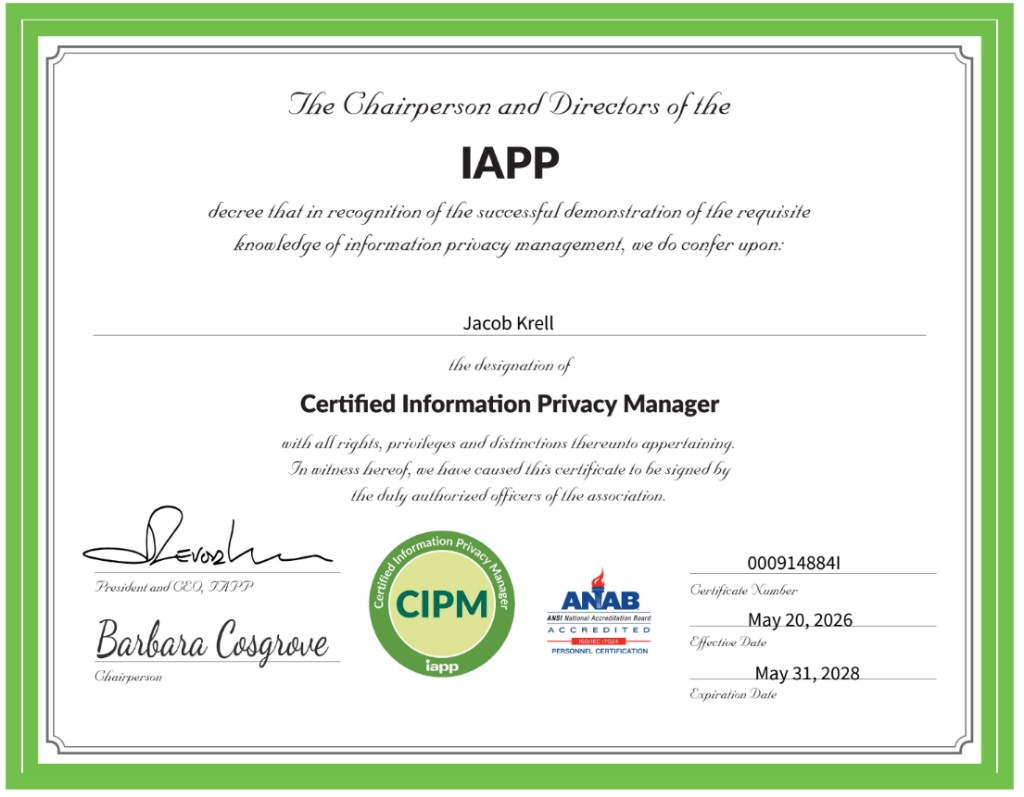
 CIPM Certified
Certification at a Glance
Overview
The IAPP Certified Information Privacy Manager (CIPM) is widely recognized as the leading ANSI/ISO 17024 accredited certification focused specifically on privacy program management. Where the IAPP's CIPP certifications test knowledge of privacy laws and regulations, the CIPM tests whether you can actually build, implement, and run a privacy program across its full operational lifecycle. The IAPP describes it as the "how" of privacy operations, and that framing is accurate. The certification covers everything from developing the organizational vision for a privacy program through incident response and data subject rights management.
I pursued the CIPM to establish credibility for a new virtual Chief Privacy Officer (vCPO) service line. Privacy program management is increasingly in demand, and organizations looking to engage a vCPO expect the person in that seat to hold recognized credentials in the discipline. The CIPM validates exactly the operational competencies that role requires, making it the natural certification to anchor that offering.
Experienced governance and security professionals will likely find the exam approachable, particularly anyone who already holds the CISSP or has experience with governance, risk, and compliance frameworks. The overlap between the CISSP's security management domains and the CIPM's privacy program management content is substantial. This review covers what the CIPM tests, how I studied for it using an LLM based approach with no textbook, and practical tips for anyone preparing to take the exam.
What the CIPM Covers
The CIPM Body of Knowledge is organized into six domains that follow the lifecycle of a privacy program from initial conception through ongoing operations.
Domain I: Developing a Framework
This domain covers the foundational work of establishing a privacy program. It includes creating the organizational vision, gaining executive sponsorship, selecting a data governance model (centralized, distributed, or hybrid), defining the program scope and charter, and structuring the privacy team. It also covers communication strategies for building internal and external awareness of the privacy program. For anyone with CISSP experience, this domain will feel very familiar. The concepts of executive sponsorship, governance models, and program chartering translate directly from security program management.
Domain II: Establishing Program Governance
The governance domain focuses on implementation. It covers developing privacy policies, procedures, standards, and guidelines. It also addresses defining privacy program activities such as education and awareness, regulatory monitoring, data inventories, risk assessments, incident response processes, and complaint handling. A significant portion covers understanding territorial and sectoral regulations (GDPR, CCPA, HIPAA, GLBA), data sharing agreements, and developing appropriate metrics to measure program effectiveness. This was the most content heavy domain on the exam, and the metrics and regulatory monitoring material is where the CIPM starts to differentiate from general GRC knowledge.
Domain III: Assessing Data
This domain covers the assessment side of the privacy operational lifecycle. It includes documenting the current baseline of the privacy program, evaluating processors and third party vendors, conducting physical assessments, handling privacy considerations in mergers, acquisitions, and divestitures, and performing privacy assessments such as PIAs and DPIAs. The vendor assessment content is particularly relevant given how much personal data processing is outsourced to third parties. The M&A privacy content was one of the few areas that felt genuinely new compared to what the CISSP covers.
Domain IV: Protecting Personal Data
The protection domain covers information security practices, Privacy by Design (PbD), integrating privacy requirements across functional areas of the organization, and technical and organizational measures. It addresses access controls, data retention management, data destruction methods, and policies related to the full processing lifecycle from collection through disposal. Privacy by Design is the key differentiator here. The concept of embedding privacy into system development lifecycles and business processes rather than bolting it on after the fact is central to the CIPM's philosophy.
Domain V: Sustaining Program Performance
This domain is about keeping the program running effectively over time. It covers monitoring (environment, policy compliance, regulatory changes), audit alignment, and targeted training for employees, management, and contractors. The audit content includes knowledge of audit processes, compliance assessment tools, and data integrity verification. This was the most straightforward domain for me. Anyone who has operated a security or compliance program will find the monitoring and audit concepts immediately recognizable.
Domain VI: Responding to Requests and Incidents
The final domain covers two critical operational functions. Data subject rights management (access, correction, erasure, objection to processing, complaints) and privacy incident response. The incident response content is comprehensive, covering detection, handling, risk assessment, containment, remediation, notification requirements, and incident metrics. The data subject rights material is where privacy practitioners spend significant operational time, and it is distinct enough from security incident response that it warrants dedicated study even for experienced CISSP holders.
Study Approach
I took a self study approach using LLMs as my primary learning tool, with no textbook. Rather than purchasing the official IAPP training course or the Privacy Program Management textbook, I downloaded the free CIPM Body of Knowledge from the IAPP website and fed it into ChatGPT, having it teach me each domain systematically. I then purchased the official IAPP practice exam and used it as a gap analysis tool, feeding each question back into ChatGPT to understand not just the correct answer but the reasoning behind it and where it connected to the broader body of knowledge.
This approach worked extremely well, and I would go as far as to say it is the most efficient certification preparation method I have used. The LLM was able to explain concepts in multiple ways, generate additional examples, and connect topics across domains in ways that a static textbook cannot. When I encountered areas where my understanding was weak, I could drill into those specific topics immediately rather than working through an entire chapter to find the relevant material. LLMs are highly effective for comprehension and gap analysis, but they still require validation against authoritative source material. I cross-referenced key concepts against the official Body of Knowledge to ensure accuracy. Beyond the practice exam and the exam fee itself, there were no other preparation costs.
The practice test mapped very closely to the actual exam in both style and difficulty. If you are scoring well on the practice questions, you should feel confident going in. It took me roughly three weeks from start to exam day. Given the significant overlap with my existing CISSP knowledge, I could have compressed the timeline to two weeks comfortably. For a new learner without a GRC background, I would recommend about a month of dedicated study.
Exam Experience & Tips
For experienced GRC or CISSP-level practitioners, the exam difficulty is moderate and substantially less technical than advanced security certifications. The questions were not overly technical, and most could be reasoned through with a solid understanding of how privacy programs operate within organizations. Very little rote memorization was required. If you understand the logic behind why privacy programs are structured the way they are, you can work through the vast majority of the questions without having memorized specific definitions or frameworks. Newcomers to governance and compliance should expect a steeper learning curve, but the exam remains approachable with focused preparation.
Scenario based questions are heavily weighted on the exam. These present a situation and ask what the privacy manager should do, which means understanding the principles well enough to apply them matters far more than memorizing vocabulary. I took the exam online through Pearson VUE. The proctoring experience was smooth and unremarkable, which is exactly what you want from an online proctored exam.
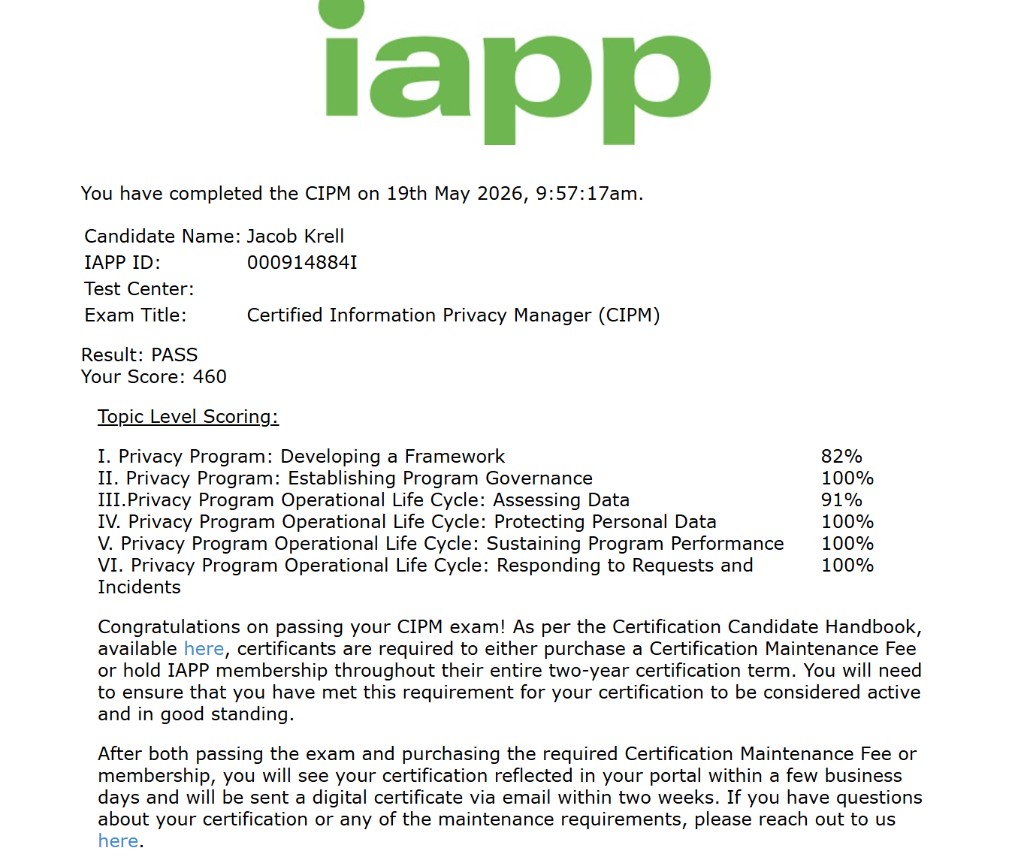
Official score report: PASS with 460 / 500 (May 19, 2026).
I passed with a score of 460 out of 500. My domain breakdown was as follows:
| Domain | Score |
|---|---|
| I. Privacy Program: Developing a Framework | 82% |
| II. Privacy Program: Establishing Program Governance | 100% |
| III. Privacy Program Operational Life Cycle: Assessing Data | 91% |
| IV. Privacy Program Operational Life Cycle: Protecting Personal Data | 100% |
| V. Privacy Program Operational Life Cycle: Sustaining Program Performance | 100% |
| VI. Privacy Program Operational Life Cycle: Responding to Requests and Incidents | 100% |
Tips
Leverage LLMs throughout your preparation. This was the single most effective study strategy I have used for a certification exam, and it will be my default approach going forward. Specifically:
Do not overthink the preparation. If you have a GRC background or hold the CISSP, you already know much of this material in a different context. Focus your study time on privacy specific concepts like Privacy by Design, DPIAs, and data subject rights management rather than trying to cover every domain equally.
Comparisons & Recommendations
How the CIPM Compares
Within the IAPP ecosystem, the CIPM sits alongside the CIPP and CIPT certifications. The CIPP variants (US, E, A, C) cover the "what" of privacy: laws, regulations, and jurisdictional requirements. The CIPT covers the "where": embedding privacy into technology, products, and systems. The CIPM covers the "how": operationalizing privacy into a managed program. These are designed as complementary, not competing, credentials. Holding a CIPP alongside the CIPM is a core requirement for the IAPP Fellow of Information Privacy (FIP) designation. I plan to pursue the CIPP/US next to complete that stack.
Outside the IAPP family, several certifications cover adjacent ground. The table below compares the CIPM against privacy certifications that target operational, management, or engineering roles rather than pure legal knowledge.
| Certification | Provider | Focus | Format / Cost | How CIPM Differs |
|---|---|---|---|---|
| CDPSE | ISACA | Privacy engineering, implementing privacy-by-design into systems, networks, and applications | 120 MCQ, 3.5 hrs, 450/800 to pass. $575 member / $760 non-member. Requires 3 yrs experience. | CDPSE is technical and hands-on, covering privacy architecture, data lifecycle controls, and engineering safeguards. CIPM is organizational, focused on building and governing the program those engineers operate within. They sit on opposite sides of the same problem. |
| PECB CDPO | PECB | Data Protection Officer role under GDPR, compliance measures, controller/processor responsibilities, and technical/organizational safeguards | 80 MCQ, open-book, 70% to pass. $1,000 standalone / included with training (~$850+). Requires 5 yrs experience for full credential. | PECB CDPO is GDPR-centric and trains you to fill the specific statutory DPO role. CIPM is jurisdiction-agnostic and covers the full privacy program lifecycle regardless of which regulation applies. CIPM is broader in scope but shallower on GDPR specifics. |
| ISO 27701 LI | PECB | Designing, implementing, and operating a Privacy Information Management System (PIMS) aligned to ISO/IEC 27701 | 12 questions (stand-alone + scenario), 70% to pass. $1,000 standalone / included with training. Requires 5 yrs experience for Lead credential. | ISO 27701 LI is standards-based and builds a certifiable PIMS on top of an existing ISO 27001 ISMS. CIPM is framework-agnostic and teaches privacy program management without requiring ISO alignment. Choose ISO 27701 LI when you need to certify an organization against a standard, choose CIPM when you need to run a privacy program operationally. |
| IAPP CIPT | IAPP | Privacy in technology, integrating privacy requirements into products, systems, and IT infrastructure | 90 MCQ, 2.5 hrs, 300/500 to pass. $550. No prerequisites. | CIPT is the IAPP's technology-focused credential. It overlaps with CDPSE in scope but is less technical and more conceptual. CIPM focuses on the organizational program that governs the privacy engineering efforts CIPT and CDPSE address. |
| (ISC)² CISSP | ISC² | Broad security management, governance, risk, compliance, architecture, and operations across eight domains | 125-175 adaptive, 4 hrs, 700/1000 to pass. $749. Requires 5 yrs experience. | Significant conceptual overlap in governance, risk, and program management. CISSP is broader but shallower on privacy. CIPM is narrower but deeper on privacy program operations. Holding both is complementary. |
The CIPM is widely recognized as the leading ANSI/ISO 17024 accredited certification focused specifically on privacy program management. The CDPSE is the closest competitor in terms of industry recognition, but it targets a fundamentally different role: the engineer who implements privacy controls versus the manager who builds and governs the program. The PECB credentials (CDPO and ISO 27701 Lead Implementer) are well regarded in European and standards-heavy environments but carry significantly higher cost barriers and experience requirements.
For anyone building a privacy career from the management side, the CIPM paired with a CIPP is the most efficient and widely recognized combination. Adding the CISSP provides the broader security management context, and the CDPSE or CIPT fills the technical gap if your role touches implementation.
Who Is This For?
The CIPM is well suited for:
If you already hold the CISSP and work in a role that touches privacy, the CIPM is a natural addition that formalizes knowledge you likely already have in practice. If you are new to both security and privacy, the CIPM is still accessible, but expect to invest more study time in the governance and risk management concepts.
What the CIPM Does Not Cover Well
The CIPM provides strong operational structure for privacy program management, but it does not deeply cover the technical realities of implementing privacy at scale. Practitioners should be aware of these gaps:
None of these gaps diminish the value of the CIPM. They simply define its boundaries. The certification teaches you how to structure and govern a privacy program. The implementation details, tooling decisions, and organizational navigation are skills you build through practice.
Final Verdict
The CIPM is a practical certification that validates the operational side of privacy program management. For experienced GRC and security professionals, the content will feel familiar and the exam will be straightforward. For newcomers to privacy, it provides a well structured framework for understanding how privacy programs are built, operated, and sustained across an organization.
What stands out most from this experience is the study method. Using an LLM to learn the body of knowledge, generate scenario questions, and decompose practice test answers proved more effective and dramatically cheaper than traditional training. I expect this approach to become my default for future certifications.
The CIPM earns its place alongside the CISSP for anyone operating in the privacy space. Combined with a CIPP, it provides the full picture: the legal knowledge and the operational capability to turn that knowledge into a functioning privacy program.
Ready to get started? Check out the CIPM certification on the IAPP website and download the Body of Knowledge to begin your preparation.
Verify my CIPM credential on Credly.